Learning with Concept Maps
Estimated reading time: 4 minutes.
When you need to learn a new domain, whether it's a client's business, a technology stack, or a scientific topic, where do you start? Most people read articles, take notes, and hope it sticks. But there's a better way.
Concept Maps turn passive reading into active understanding. By creating a Concept Map, you force yourself to answer the hardest question in learning: "How does this relate to that?" And it's precisely this question that transforms scattered facts into real understanding.
Why Concept Maps Work for Learning
Joseph D. Novak, who developed Concept Maps in the 1970s, built them on a key insight from learning science: meaningful learning happens when you actively connect new knowledge to what you already know. Simply memorising facts doesn't create understanding. Forming relationships between concepts does.
When you create a Concept Map, you are not just recording information. You are constructing your understanding. Every time you write a proposition like "Typeface defines Glyph", you are making a falsifiable claim. You can check it. You can challenge it. And the act of deciding on that relationship is where learning actually happens.
This is why Concept Maps are more effective than traditional notes. Notes are a list of facts. A Concept Map is a network of relationships. The network reveals gaps in your understanding that a list never will.
Three Structures and What They Tell You
Research by Kinchin, Hay, and Adams identified three structural patterns in Concept Maps. Each one reveals something about the depth of understanding behind it.
The Spoke
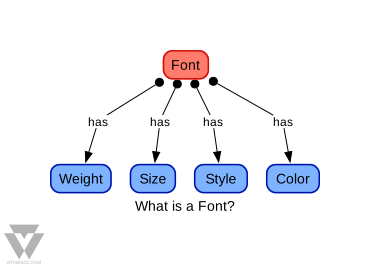
In a spoke, one central concept connects to everything else, but the surrounding concepts have no relationships with each other. This looks like a tidy diagram, but it's really just a list in disguise: "Font has Weight", "Font has Size", "Font has Style", "Font has Color".
The problem? Weight, Size, Style, and Color exist in isolation. Remove Font and the map falls apart. This structure indicates a superficial understanding, a vocabulary without grammar.
The Chain
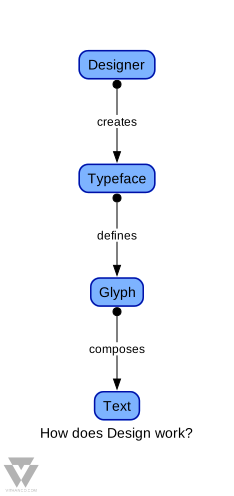
In a chain, concepts connect in a linear sequence: Designer creates Typeface, Typeface defines Glyph, Glyph composes Text. There is exactly one path through the map.
The problem? If you don't understand one concept in the middle, everything downstream disconnects. Chains indicate sequential thinking. You can recite the steps, but you cannot explain why any particular step matters or how it connects to the bigger picture.
The Network
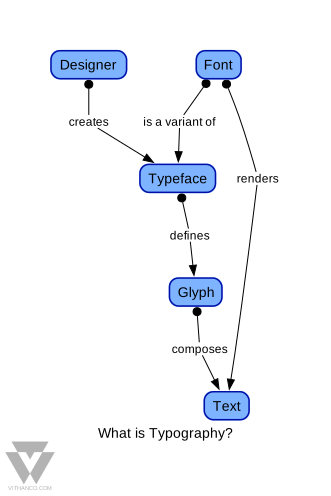
A network has multiple paths between concepts. You can reach Text from Typeface via Glyph or via Font. Designer connects to Typeface, but so does Font through a different relationship. Each concept participates in several propositions.
This is the structure to aim for. It indicates deep, flexible understanding. You can approach the topic from multiple angles. You can explain relationships in different ways. And when new information arrives, it integrates naturally because there are multiple connection points.
How to Learn with Concept Maps
1. Define a Guiding Question
Start with a question that scopes what you want to understand. "What is Typography?" is good. "Everything about design" is too broad. The guiding question determines what belongs on the map and what doesn't.
2. Brainstorm Concepts
From your reading, research, or experience, list the key terms and ideas. Don't worry about relationships yet. Just collect the vocabulary of the domain.
3. Find Relationships
This is the critical step. For each pair of concepts, ask: "How does X relate to Y?" Express the relationship as a short verb or phrase. The result should read as a natural sentence: "Font is a variant of Typeface", "Glyph composes Text".
If you struggle to articulate a relationship between two concepts, that's a signal. Either the relationship is more nuanced than you thought (dig deeper) or the concepts belong in different parts of the map.
4. Check Your Propositions
Read each proposition aloud. Does it make sense? Is it falsifiable, could someone meaningfully disagree? If a proposition is too vague ("Font relates to Text") then sharpen it ("Font renders Text").
5. Iterate
Your first map will not be perfect. As you learn more, you will discover new concepts, revise relationships, and restructure the map. This is expected and valuable.
Watch for spoke and chain patterns. If your map is a spoke, ask: "How do the outer concepts relate to each other?" If it's a chain, ask: "Are there shortcuts or alternative paths I'm missing?"
A Practical Tip
The relation-to-concept ratio is a simple quality indicator. Count the number of relationship nodes and divide by the number of concept nodes. A chain of 5 concepts has 4 relationships (ratio 0.8). A well-connected network of the same concepts might have 8 relationships (ratio 1.6). If your ratio is low, look for missing connections.
Further Reading
- The Theory Underlying Concept Maps and How to Construct Them — Novak & Cañas, IHMC
- Using Concept Maps to Reveal Conceptual Typologies — Kinchin, Hay & Adams
- How to Study: Concept Maps — Cornell University Learning Strategies Center