
Explore Vithanco's Rich Library of Notations
At the heart of Vithanco's capabilities is its diverse and versatile library of Notations. Each Notation serves as a unique graphical language, complete with its own set of Node Types. The real strength of these Node Types lies in their ability to establish connections through Edges, enabling you to build structured and meaningful diagrams. Vithanco supports an array of Notations right out of the box, ready to streamline your processes and enhance your problem-solving capabilities.
You can use these Notations as you like but we recommend that you use the Methods whenever possible.
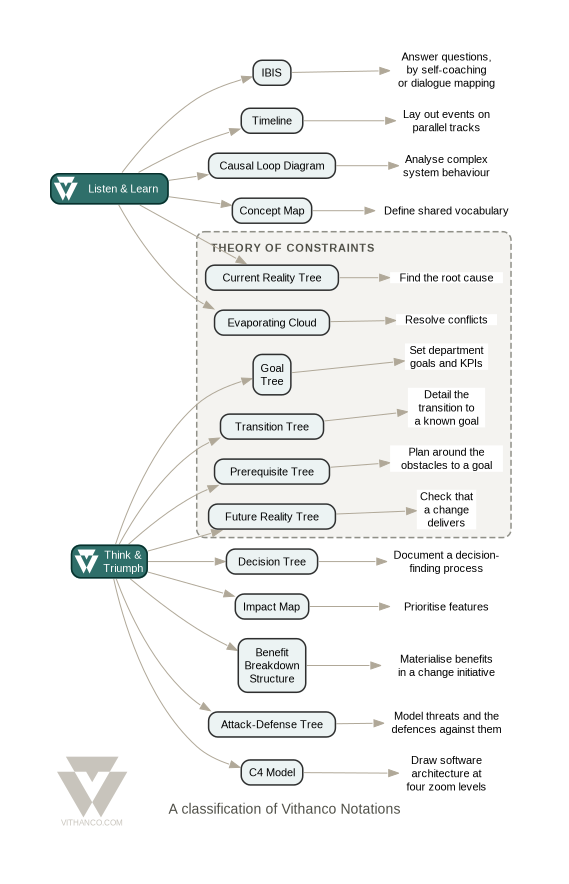
Choosing the right Notation for your particular use case is like selecting the right language to express your thoughts most effectively. We differentiate the inbuilt notations based on a two-stage approach. We as knowledge workers must in most cases understand where we are operating and then we can plan and execute. Hence we differentiate between Listen & Learn Notations and Think & Triumph Notations. More on this classification later.
vgl-render id=vithanco-overview-notations alt="Notations define the Meta Model of a graph" caption="Notations define the Meta Model of a graph, providing structure to your thoughts and ideas." class="img-std" vgraph vithancoOverviewNotations: ConceptMap "Vithanco Overview" { node graphN: Concept "Graph"; node notation: Concept "Notation"; node nodeTypes: Concept "Node Type(s)"; node visRep: Concept "Visual Representation"; node clusters: Concept "Group(s)"; node nodesN: Concept "Node(s)"; node edgesN: Concept "Edge(s)";
node rGuides: Relation "creation and manipulation is guided by"; node rContains: Relation "contains"; node rDefinesValid: Relation "defines valid"; node rDefines: Relation "defines"; node rConsists: Relation "consists of"; node rCanHave: Relation "can have"; node rGroups: Relation "groups"; node rConnects: Relation "connects two"; node rUsedBy: Relation "used by";
edge graphN -> rGuides; edge rGuides -> notation; edge notation -> rContains; edge rContains -> nodeTypes; edge notation -> rDefinesValid; edge rDefinesValid -> edgesN; edge nodeTypes -> rDefines; edge rDefines -> nodesN; edge visRep -> rConsists; edge rConsists -> nodesN; edge visRep -> rCanHave; edge rCanHave -> clusters; edge clusters -> rGroups; edge rGroups -> nodesN; edge edgesN -> rConnects; edge rConnects -> nodesN; edge edgesN -> rUsedBy; edge rUsedBy -> visRep; }
## Vithanco Graph Language (VGL)

Behind all of Vithanco's visual Notations is the **[Vithanco Graph Language (VGL)](/tools/vgl)** - a powerful, human-readable text format for creating and editing graphs. VGL provides a simple, declarative syntax that allows you to:

- Define nodes, edges, groups, and their attributes in plain text
- Work with any Vithanco Notation (IBIS, BBS, TOC, etc.)
- Create and modify graphs programmatically
- Enable version control and collaborative editing of diagrams

Whether you prefer visual or text-based editing, VGL gives you the flexibility to work the way you want. Explore the **[VGL Guide](/tools/vgl)** to learn the syntax and see examples of how to express your diagrams as code.

Ready to dive deeper? Explore our range of [Change Management Notations](/notations/Change/index) and discover the perfect graphical language for your needs.