 Home
Explore Vithanco's Rich Library of Notations
The Current Reality Tree (CRT) Notation
Home
Explore Vithanco's Rich Library of Notations
The Current Reality Tree (CRT) NotationThe Current Reality Tree (CRT) Notation
Estimated reading time: 3 minutes.
Why Use Current Reality Trees (CRTs)?
CRTs employ 'If... Then...' statements to address 'WHAT to change?' They serve as the initial step in applying the TOC thinking processes, leading to the discovery of the root cause – the single item to change for the most significant impact.
Essentially, CRTs are a form of root cause analysis. They assume that even if numerous problems exist in a specific area, they all stem from one or a few root causes. CRTs model the cause-and-effect relationship between these problems (known as "Undesirable Effects" or UDEs) and their causes.
What sets CRTs apart from other root cause analysis methods is the underlying sufficient cause or diagram logic. In the diagram, each edge A -> B must be verifiable as "if A, then B."
The process is complete when all UDEs are connected, and you can identify the single effect that requires modification for the most significant impact.
CRT Notation Description
The diagram below outlines the Notation's grammar. CRTs begin by listing the known Undesirable Effects (UDEs) in a specific area. It is recommended to collect between 5 and 10, but more can be included if necessary.
Next, follow the sufficient cause logic to identify the causes. Each cause is an effect in itself (desirable, undesirable, or intermediate). Two additional "causes" typically appear at the bottom of the diagram: "Given" causes, which cannot be changed, and "Changeable" causes, which can and should be altered to mitigate problems from reoccurring. These are the most interesting causes since changing them is the easiest way to enact change.
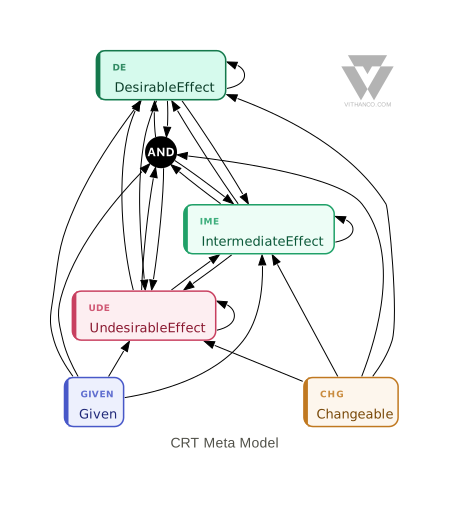
The Node Types in detail:
| Node Type | Description | Successors |
|---|---|---|
| Undesirable Effect | These are starting points for current reality trees. They represent unwanted outcomes that are caused by other events or conditions. | All Effects incl. 'And' |
| Intermediate Effect | These represent outcomes that aren't necessarily good or bad. They too are caused by other events or conditions. | All Effects incl. 'And' |
| Desirable Effect | These are outcomes you want to achieve. Like others, they're caused by other events or conditions. | All Effects incl. 'And' |
| Given | These are constants, things you can't change. For example, gravity is a given - unless you leave Earth, it's always there. | All Effects incl. 'And' |
| Changeable | These represent conditions that can be changed to prevent issues from happening again. | All Effects incl. 'And' |
| And Junctor | These are used in diagrams to show that an outcome happens only when two conditions are both present. | All |
Is there anything else you need assistance with?
The Notation setting will highlight those effects (desirable, undesirable or intermediate incl. And Junctor) that are connected to a cause. This way the not-yet-connected effects are highlighted, so you can focus on them.
Background Information on CRT Notation
CRT diagrams were developed as part of the Theory of Constraints by E. Goldratt. More on the Theory of Constraints can be found here.
Try CRT Yourself
Create and visualize your own Current Reality Tree diagram right here in your browser. Edit the VGL (Vithanco Graph Language) text on the left and click "Render" to see your diagram:
Tip: Use Ctrl+Enter (or Cmd+Enter on Mac) to quickly render your graph while editing.
Want to learn more about the VGL syntax? Check out the complete VGL Guide for detailed documentation on creating graphs in text format, including syntax reference and examples for all supported notations.
Example
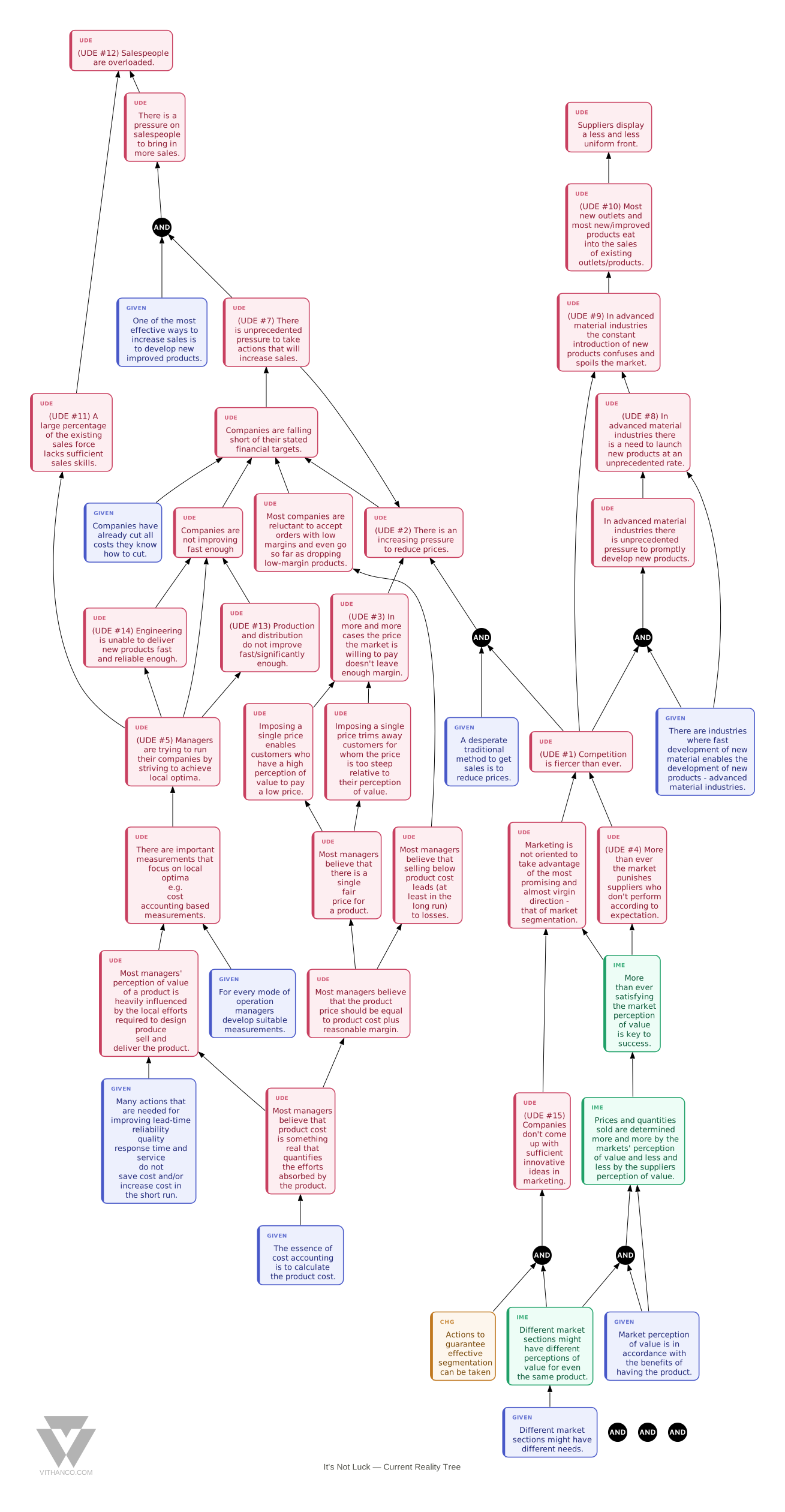
In the book It's not Luck Goldratt's hero Alex Rogo is creating a medium-sized Current Reality Tree.