 Home
Explore Vithanco's Rich Library of Notations
The Goal Tree (GT) Notation
Home
Explore Vithanco's Rich Library of Notations
The Goal Tree (GT) NotationThe Goal Tree (GT) Notation
Estimated reading time: 8 minutes.
Why Use Goal Trees (GTs)?
The Goal Tree is a strategic planning tool that defines what a system (typically an organization) must achieve in order to fulfill its purpose. It answers the fundamental question: "What must we achieve to reach our Goal?"
Unlike the other TOC Thinking Process tools which diagnose problems or plan changes, the Goal Tree establishes the aspirational foundation. It captures what "good" looks like for the system by articulating a single overarching Goal, the handful of Critical Success Factors required to achieve it, and the network of Necessary Conditions that support those factors. Once defined, the Goal Tree serves as a constant reference point — a strategic beacon — keeping day-to-day decisions aligned with long-term purpose.
The Goal Tree is the core of the Logical Thinking Process. It informs every other logic tree: the Current Reality Tree (CRT) identifies where the organization is falling short of its Goal Tree, the Evaporating Cloud (EC) resolves conflicts between competing Necessary Conditions, the Future Reality Tree (FRT) validates proposed changes against the Goal Tree, and the Prerequisite Tree (PRT) plans the implementation path.
When to Use Goal Trees
- You need to align an organization around its purpose. The Goal Tree forces a group to reach consensus on what the system exists to achieve. Even executives who have worked together for years often discover they hold different assumptions about the goal.
- You want to establish success criteria before diagnosing problems. A Goal Tree defines the benchmark. Without it, a CRT has no reference for what "should be" — Undesirable Effects are simply failures to satisfy elements of the Goal Tree.
- You are starting a strategic planning process. The Goal Tree is the natural first step. It identifies what must go right before you examine what is going wrong.
- You need to connect daily operations to long-term purpose. Because NCs cascade from abstract to concrete, the Goal Tree bridges the gap between senior leadership's vision and the functional tasks performed by individuals.
When NOT to Use Goal Trees
- If you already have a validated Goal Tree and need to diagnose current problems, use a CRT instead.
- If you need to resolve a specific conflict between two approaches, use an EC instead.
- If you need to plan how to overcome obstacles on the way to a known objective, use a PRT instead.
GT Notation Description
The Goal Tree uses necessity-based logic (necessary condition thinking). Every connection in the tree reads as: "In order to achieve [upper node], we must have [lower node]." This logic gives the tree its distinctive property: every element at every level is equally important, because a failure at any level prevents the Goal from being reached.
The diagram is laid out top-to-bottom, with the single Goal at the top, Critical Success Factors in the next layer, and Necessary Conditions cascading downward into increasing levels of detail.
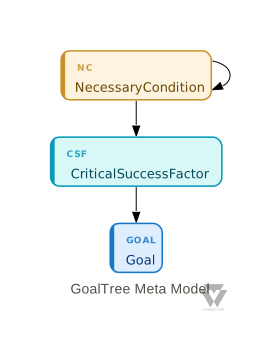
| Node Type | Description | Successors |
|---|---|---|
| Goal | The ultimate purpose for which the system exists. There is always exactly one Goal, placed at the top of the tree. It states the end to which the system's collective efforts are directed. | - |
| Critical Success Factor | A high-level terminal outcome without which the Goal cannot be achieved. Typically 3 to 5 CSFs sit directly below the Goal. They represent the last things that must happen before the Goal is realized, each summarizing the outcome of many subordinate activities. | Goal |
| Necessary Condition | An indispensable functional task or prerequisite that supports either a CSF or another NC. NCs can cascade into multiple levels, becoming more detailed, specific, and operational at lower tiers. They may also have lateral cross-connections between branches when a condition supports elements in different parts of the tree. | Critical Success Factor, Necessary Condition |
Key Properties of the Goal Tree
- Single Goal: Every Goal Tree has exactly one Goal at its apex. If the system has more than one apparent goal, the tree-building process forces clarification of which is the true purpose and which are supporting conditions.
- Limited CSFs: The number of Critical Success Factors is deliberately small (usually 3 to 5). They represent the broadest categories of achievement necessary for the Goal.
- Cascading NCs: Necessary Conditions form the bulk of the tree. At the highest level they are still relatively abstract; at lower levels they become concrete and actionable. There is no inherent limit to the depth of NC layers.
- Equal importance at every level: Because the logic is necessity-based, vertical placement says nothing about relative importance. A low-level NC is just as critical as a CSF — if any necessary element is missing, the Goal cannot be achieved.
Constructing a Goal Tree
Building a Goal Tree is a top-down process:
- Define the Goal. Write a concise statement of the system's ultimate purpose. This often takes longer than expected — Dettmer reports that even senior leadership teams may need an hour or more to reach consensus on a single sentence.
- Identify the Critical Success Factors. Ask: "What are the few high-level outcomes that must all be achieved for the Goal to be realized?" Limit these to 3–5. Each CSF should be a terminal outcome, not an activity.
- Expand into Necessary Conditions. For each CSF, ask: "What must be true for this CSF to be satisfied?" These become the first layer of NCs. Repeat the question for each NC to build deeper layers.
- Identify lateral connections. Some NCs support elements in multiple branches. Draw these cross-connections to reveal dependencies that might otherwise be overlooked.
- Validate with necessity logic. Read every connection aloud: "In order to achieve [upper], we must have [lower]." If the statement does not hold, restructure.
Three Organizational Archetypes
Dettmer observed that the Goal and CSFs are remarkably similar across organizations of the same type. He identified three archetypes:
- Commercial / for-profit: The Goal is typically financial (e.g. to increase profitability). CSFs cluster around maximizing throughput (revenue), controlling operating expense, and minimizing inventory/investment.
- Non-governmental / not-for-profit: The Goal is non-financial (e.g. a social mission). CSFs include successful mission delivery plus three financially oriented factors similar to for-profit organizations: generating income, controlling costs, and managing investment.
- Government agencies: The Goal is mission accomplishment (e.g. public service delivery). CSFs focus on increasing service levels, minimizing investment, and controlling overhead. Budget appears as a supporting Necessary Condition rather than a CSF.
Recognizing your organization's archetype provides a valuable starting template. The upper layers (Goal + CSFs) can often be reused; the lower-level NCs then reflect the specific, functional details unique to each organization.
Nested Goal Trees
Large organizations often contain sub-systems (divisions, departments) that each have their own Goal Tree. In such cases, the sub-system's Goal becomes a Necessary Condition in the parent system's tree. Similarly, the sub-system's CSFs may correspond to NCs of the parent tree's CSFs. This nesting creates a traceable chain from the daily tasks of individual contributors all the way up to the organization's strategic purpose.
Background Information on GT Notation
The Goal Tree was created by H. William Dettmer around 2001–2002, originally under the name "Strategic Intermediate Objectives Map" (S-IO Map). It was subsequently named "Goal Tree" by Martin Burns of Deloitte Consulting, a name that became widely adopted. Dettmer developed it as an extension and refinement of the TOC Thinking Processes originally conceived by Eliyahu Goldratt. More on the Theory of Constraints can be found here.
The Goal Tree fills a role that Goldratt's original five thinking processes left implicit: explicitly defining the system's purpose and success criteria before analyzing what is going wrong (CRT) or deciding what to change (EC, FRT). When used alongside the CRT, Undesirable Effects can be understood as failures to satisfy specific Necessary Conditions, CSFs, or the Goal itself, providing a direct link between the aspirational structure and the diagnostic analysis.
Structurally, the Goal Tree shares many characteristics with the Prerequisite Tree (PRT): both culminate in a single outcome at the top, both use necessity-based logic, and both consist of a network of conditions arranged in parallel branches that can cross-connect. The key difference is purpose: the PRT is a planning tool for overcoming obstacles on the way to a known objective, while the Goal Tree is a definitional tool that articulates what the objectives should be in the first place.
References
- Dettmer, H. William. "The Origin of the Goal Tree." TOCICO, 2022. Available at tocico.org.
- Dettmer, H. William. "Our goal is...What is our goal?" Goal Systems International, 2011. Available at readkong.com.
- Dettmer, H. William. The Logical Thinking Process: A Systems Approach to Complex Problem Solving. ASQ Quality Press, 2007.
Try GT Yourself
Create and visualize your own Goal Tree diagram right here in your browser. Edit the VGL (Vithanco Graph Language) text on the left and click "Render" to see your diagram:
Tip: Use Ctrl+Enter (or Cmd+Enter on Mac) to quickly render your graph while editing.
Want to learn more about the VGL syntax? Check out the complete VGL Guide for detailed documentation on creating graphs in text format, including syntax reference and examples for all supported notations.
Example
The interactive widget above shows the generic Goal Tree for a commercial, for-profit company — adapted from Dettmer's work. The three CSFs (Maximize Throughput, Control Operating Expense, Minimize Inventory) recur with only minor wording variations across virtually all for-profit organizations, from automobile manufacturers to bakeries. The differences between companies emerge at the NC level, where the specific functional tasks reflect each organization's unique operations.
This archetype is a practical starting point: identify your organization's type, adopt the corresponding generic Goal + CSFs, then build out the NCs that describe your specific reality. Verbalizing each connection ("In order to maximize throughput, we must maximize sales volume") quickly exposes gaps or incorrect assumptions, making the Goal Tree both a communication tool and a diagnostic instrument.